
The Biological Bond: Why We Are Hardwired for Holiday Lights
Have you ever felt it? That quiet, unmistakable spark of joy when you spot the first string of holiday lights in your neighborhood. It’s a feeling that seems to cut right through the crisp, early dark of a winter evening. We often call it "holiday spirit," but it is actually something much older and more profound. This deep, universal pull toward illuminating the darkest month of the year isn’t just a tradition we invented; it’s an answer to a biological call.
As the Northern Hemisphere tilts away from the sun, our bodies physically feel the absence. The long dark leads to serotonin depletion, impacting our mood and energy. In this light, the act of hanging a bulb is a deeply human, almost instinctual act of defiance. We are, in our own small way, engineering a little more daylight, a little more warmth, and a little more hope.
Our Ancestors and the First Fire
To truly understand our modern obsession with light, we have to imagine a world without a switch on the wall. For our ancestors, the winter solstice wasn’t just a date; it was a period of genuine anxiety. The sun, their source of life, was disappearing. They fought back with fire. In ancient Persia, families gathered for the festival of Yalda, refusing to sleep until the sun returned. The Romans, during Saturnalia, lit wax tapers everywhere. In a time of winter scarcity, burning light so freely was a declaration that life and generosity would not be extinguished.
Further north, the Germanic and Norse peoples practiced a different kind of magic. The original Yule log wasn’t a dessert, but a colossal tree dragged into the communal hall to burn for days. It was a thermodynamic necessity, but it was also spiritual protection. They believed the flames chased away malevolent spirits that roamed the long nights. When we wrap a string of lights around a tree today, we are performing a safer, modern version of this same act—bringing the life-giving fire indoors to create our own small sun.
From the Hearth to the Heavens
While our ancestors looked to the fire on the ground, another story eventually asked us to look toward the sky. The Star of Bethlehem serves as the central icon of light in the Christmas narrative. Whether it was a rare triple conjunction of Jupiter and Saturn, as astronomer Johannes Kepler theorized, or a passing comet, it cemented the idea that light is the medium of the miraculous. The star we place atop our tree is a direct echo of this story—a symbol of guidance and a promise that even in the deepest darkness, there is a light to lead us home.
The Dangerous Dance of Candlelight
For centuries, bringing that celestial glow indoors was a beautiful but terrifying affair. The tradition of the candle-lit tree, attributed to Martin Luther’s attempt to recreate a starry sky for his children, was an exercise in high-stakes risk. A dry fir tree covered in open flames is a disaster waiting to happen. In early modern Germany, lighting the tree was a brief, breathless ceremony—lasting perhaps only fifteen minutes—while the family stood guard with buckets of water and sand. The light was precious because it was fleeting; its beauty was sharpened by its peril.
Flipping the Switch on Tradition
The man who finally made the modern holiday possible wasn't just Thomas Edison, but his associate, Edward H. Johnson. In 1882, Johnson hand-wired 80 red, white, and blue bulbs onto a tree in his New York parlor. It was a deliberate publicity stunt to prove that electricity was safe enough to wrap around a tinder-dry tree. For decades, this remained a luxury of the ultra-rich, costing the equivalent of thousands of dollars today to hire an electrician and rent a generator. It wasn't until companies like NOMA emerged in the 1920s that this magic was democratized.
This era of safety unleashed a wave of mid-century creativity, perhaps best exemplified by the iconic Bubble Light. For anyone who grew up with them, the memory is indelible: a glass tube of liquid that, when heated by the bulb, erupted in a hypnotic dance of bubbles. It was science and magic rolled into one, proving that light could have life, movement, and personality.
The Light We Remember
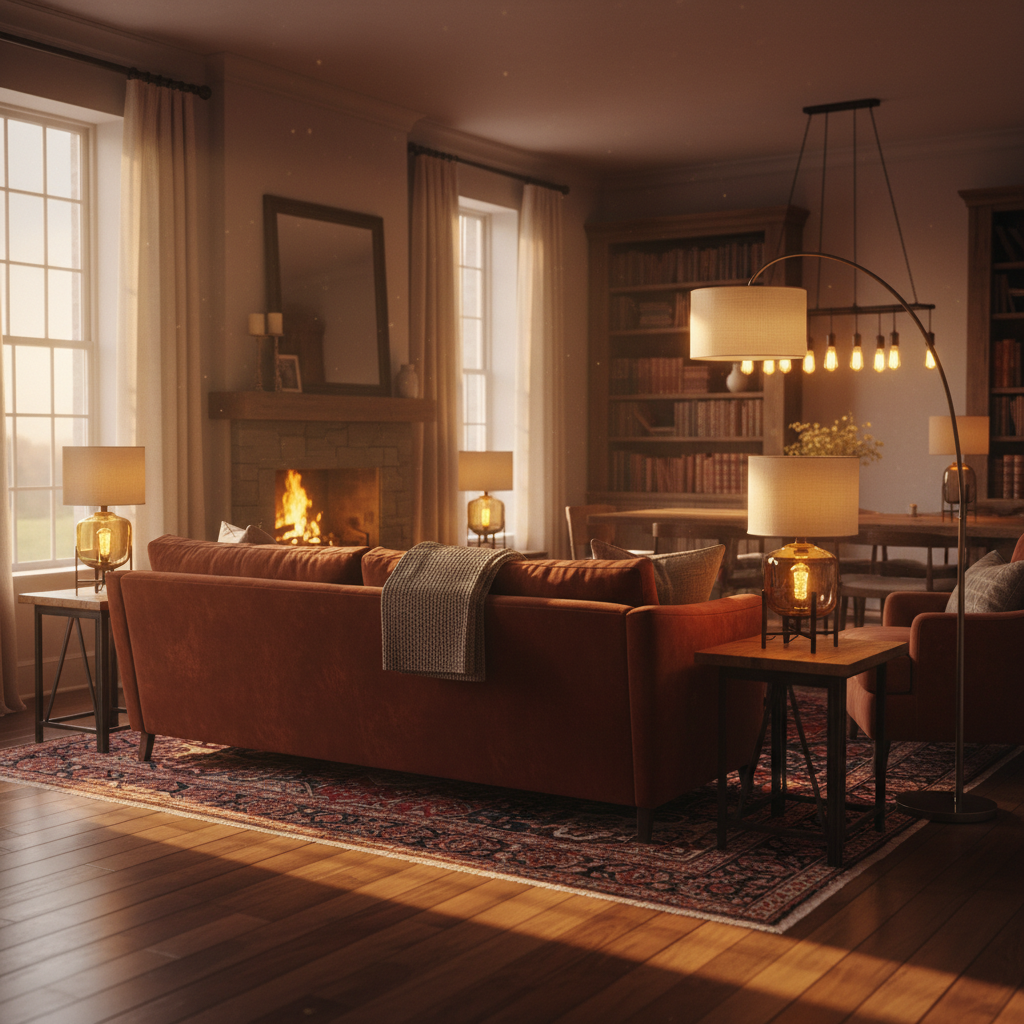
The evolution of lighting technology tells a fascinating story about our own psychology. When LEDs first arrived, they were a marvel of efficiency, but they felt "wrong." They glowed with a cold, bluish light that felt clinical. We didn't embrace them because we weren’t just seeking brightness; we were seeking a feeling. We wanted the warm, amber glow of firelight—a color that lives deep in our evolutionary memory as the hue of safety.
This "color temperature war" forced engineers to become artists. They had to redesign LEDs to replicate the 2700K warmth of an incandescent bulb. At DUA, this is our core philosophy: precision engineering is only half the equation. The other half is narrative. Whether it’s a gentle twinkle that restores a tired mind or a warm glow that turns a room into a sanctuary, light is never just about seeing. It’s about feeling.
Our Modern Glow, and Its Shadow
Today, the affordability of light allows us to paint our homes on a scale never before imagined—from a single porch string to massive, Griswold-esque displays. However, this abundance brings a new responsibility. Satellite data shows that holiday lighting can increase suburban brightness by 50%, creating a "sky glow" that disrupts migratory birds and wildlife.
But as technology creates challenges, it also offers solutions. The future is moving toward smart, sustainable displays. We are seeing the rise of projection mapping—painting a home with light and imagery without a single plastic strand—and permanent, programmable IoT tracks that eliminate annual waste.
A Primal Act of Faith
The story of Christmas lighting is a remarkable journey. It begins with our biology—a primal response to the dying of the light—and ends with AI-driven displays. The technology, from tallow candles to filaments to photons, is always changing. But the message has never wavered. Every light we turn on is a small act of faith, a declaration that we are here, that we are together, and that in the heart of winter, the light will always return.